There seems to be something fundamentally lacking in most book reviews. So many book reviews I see get so caught up in some specific aspect of the book, like the symbolism, or how tragic the ending was, that they tend to ignore the whole point of reading in the first place. Sure, we read for a lot of reasons, we read to learn, we read to study, we read to not fail that class, or to impress that cute person on the train. But, for the most part, we’re reading for pure enjoyment, because we want to lose ourselves in a story for awhile. We’re not reading to look for symbolism, or to analyze a character’s motivations, or to figure out what a story has to tell us about the author’s experiences in the war. We’re reading for fun. So why don’t reviews take that into consideration?
Reviewers tend to write their reviews as if there’s only one universal viewpoint. If they think a book is good, it’s Good™, and everyone should think so. If they think a book is bad, it’s The Worst Book Ever Written And No One Can Ever Enjoy It™. I don’t even think they know they’re doing it, because I think that’s just the natural human condition. We all think we’re right all the time, that we know more than everyone else, and anyone who disagrees is wrong and dumb, probably. We also tend to think of things as purely black-and-white issues. Something is either Good or it’s Awful, and there is no middle ground. It doesn’t matter if the book did one thing really well and a couple other things badly, if the reviewer decides that the Bad Things outweigh the Good Things, then sorry kiddos, the book is terrible and you should feel bad for reading it.
So, I’d like to do things a little bit differently. Or try to, anyway. Instead of this blog being full of typical reviews, scrubbed clean of spoilers and full of subjective opinions given as fact, we’re going to try to add some numbers into it.
“But Caitlin, you just said a couple of paragraphs ago that you wanted to talk about how books were fun? Numbers aren’t fun!”
Just bear with me, friends, I promise it will all make sense soon.
For each book review, I will rate the book from 1 to 10 in a series of categories. 10 being AMAZING, and 1 being THE WORST. The categories are:
- PLOT (Is it full of clichés? Is it boring? Does it even make sense?)
- CHARACTER DEVELOPMENT (Are the characters well-developed, or are they a bunch of nonsensical “Mary Sue”s?)
- WORLD BUILDING (How well do we get to know the world? Is the world-building spread out, or all in one big info-dump?)
- DIVERSITY (Are there female characters? POC characters? LGBTQ+ characters? Disabled characters? Are they stereotypes, or are they written like real people?)
- FUN (Is the book enjoyable to read, or does it make me want to gouge my eyes out?)
I will briefly explain each rating (WITHOUT spoiling anything…or at least with as little spoilers as possible). At the end, I will add up the scores and give the book an overall rating. After the ratings, I will insert a “read more” tag, and below that I will discuss all the things that affected my ratings that were too spoiler-y to post at the top.
I tend to read Fantasy (and some Sci-Fi) the most, so most of the reviews will cover books within that genre. But I will of course branch out occasionally, and review more typical literary fiction, romance novels, plays, short stories, or anything else that happens to take my attention.
Why am I doing this?
Because I believe that book reviews should take into account how fun a book was to read. And because I think that quantifying your opinions (along with providing evidence) will help people understand my point of view, and will help eliminate some of the “I’m right and you’re wrong and dumb” aspects of writing on the internet.
Obviously all of my reviews will be massively, massively subjective, because that’s how a review should be. No one else can tell you what to think or how to respond to a story. But I have 2 hopes for this blog:
- By providing specific ratings and explanations rather than vague explanations, my reviews can help tell you whether or not you’ll enjoy a book that you haven’t yet read.
- By accounting for factors beyond “Will this book win a Pulitzer?”, my reviews will help reflect the reading experiences of everyday people, like me, who just like reading for fun, and who aren’t looking to write an essay for English class on the juxtaposition and/or metaphors in a book.
And of course, if you ever disagree, please, let me know in the comments! The most important thing that gets forgotten about books is that every story means something different to each person who reads it. There is no one right or wrong way to read or interpret a book, so if you see something differently, just leave me a comment, and maybe we can discover something new about the book in question by discussing each other’s experiences.
So, without further ado. Welcome to Literology. I hope you stay awhile.
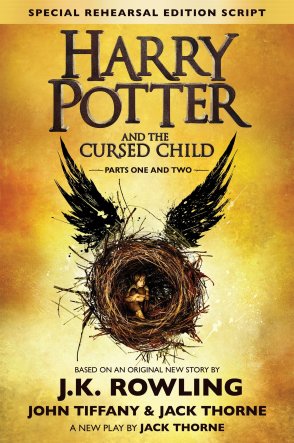 As a huge, embarrassing Harry Potter nerd, I really wanted to like this play. Harry Potter was a huge part of my childhood, and I even have a tattoo of the Deathly Hallows, so when I heard we were getting a new Harry Potter story, I was thrilled. But, even with J.K. Rowling herself helping out, this story feels less like an authentic Potter story, and more like glorified fanfiction written by someone who knows almost nothing about the books.
 Literology